The bathroom floor, measured properly
Most bathroom rugs are bought by eye and returned by tape measure. Here is the whole floor, in inches: the drip zone at the tub, the standing spot at the sink, and the awkward shape around a toilet base.
The tile is cool, the mirror is fogged, and there is a towel on the rail that somehow caught no water, but the floor did. Water falls where feet move, so the bathroom floor needs planning before it needs laundry, and you do not need to guess at it. The room tells you what to measure and where a mat belongs, because different parts of the floor do different jobs. You put the right mat in the right spot, and you size it to the realities of your door, your tub wall, your vanity face, and the curve at the base of your toilet.
Measure from the things that do not move: the walls, the vanity cabinet, the base of the toilet, and the jambs of your door. Rugs and mats succeed when they fit those fixed facts of the room, but they fail when they are too big for a swing arc, too small for a standing area, or soft in a place that stays wet. The map of the floor is three zones, not one, because you will stand at the sink, you will step out of the tub, and someone will sit and stand at the toilet. Each of those places asks for its own mat, and each measures a different way.
The standing spot at the sink
This is the place your heels plan to return to at the end of your morning, and it is usually centered on the basin, the only bathroom mat that sits in a spot that is mostly dry. You might drip from your hands after a rinse, but the surface under your toes is meant to stay out of the splash.
To size it, take a tape measure and start at the vanity face, put the hook against the cabinet and measure outward for depth, then measure the clear width available on the floor between the side obstructions that matter in your room. That might be the tub, a side wall, a linen tower, or the side of the toilet base, because you are fitting a rectangle into a slot that is defined by those fixed edges. If your vanity has a toe kick, measure on the floor, not from the overhang of a counter, because what fits under that counter is what counts.
Once you know the depth and width and the door arc, compare what you have to the sizes our cards print for bath rugs, and note that common sizes in our catalogue are 24x17, 30x20, 36x24, 48x24, and 60x24 inches. A 24x17 works in a powder room and in a narrow galley bath, and a 36x24 spans in front of a double vanity without looking lost. The fit should put your feet on the mat when you stand square to the sink, and it should not press into the toe kick or curl up a baseboard. Leave a small breathing line at each hard edge so the mat lays flat.
The drip zone at the side of the tub
The wet side matters most, and the CDC estimates that in one year, 234,094 bathroom injuries among people aged 15 and over were treated in US emergency departments, of which 81.1 percent were falls. Roughly two thirds of those injuries happened in or around the tub or shower, while only about 2.2 percent happened while getting in. The rest of that tub-and-shower share happened bathing, showering, or getting out, when the surfaces are wet, which is the exact moment your foot leaves a slick floor and lands on whatever is waiting next to the tub wall.
Do not confuse the mat on the wet side with the one that lives inside the tub, because they are different objects with different tasks. Inside the tub, the right choice is a suction rubber mat that grips a smooth clean surface, and it stays put under running water while you shower or bathe, but it will not hold on a textured tub floor or on a freshly refinished surface. The outside mat should not cross the wall and sit in standing water, because chenille inside the tub turns into a sponge that slides and a suction mat outside the tub starves the floor of air and keeps everything damp. That is how mildew begins. Two zones, two mats.
To measure the drip zone, start from the tub wall, not from the outer trim or a curtain, and hook the tape at the wall tile, then pull straight out to find the usable depth before you hit a walkway or a toilet base. Now measure the width of the space that runs along the tub, which in many bathrooms lives between the tub wall and the front of a vanity cabinet, and fit the width to the clear span you have. If a 48x24 bath rug runs neatly from the front of the vanity to just short of the toilet base, that is a win, but if a larger 60x24 would push into the arc of the door, size down.
Inside the tub and shower
The only mat that belongs inside the tub or on the floor of a shower is a suction rubber mat, and ours are cut at 35x16 inches for a tub floor and 21x21 for a square shower stall. The cups need a smooth clean surface to hold, because a textured floor breaks the seal and a freshly refinished surface is delicate and may not allow a bond. Clean the surface, rinse it well, and press the mat down from the center out so the cups seat, and if you feel a bubble, lift and reset. Do not rely on a fabric rug for this job.
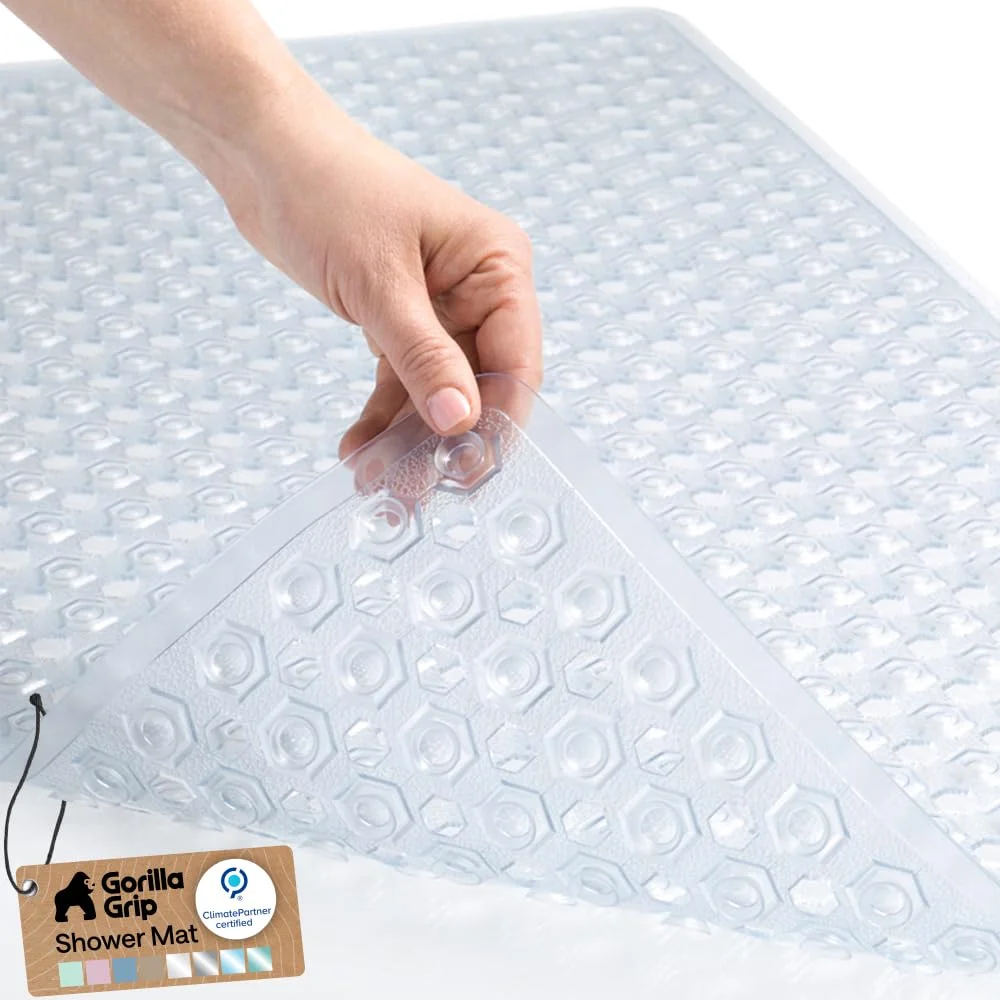
Suction has its own failure modes and its own piece: Suction, and the tub floors it will not hold covers the surfaces that cannot be sealed against and what to put down instead.
There is currently no active US voluntary standard for a slip-resistant bathing surface, because ASTM F462, which was the consumer safety specification for slip-resistant bathing facilities, was withdrawn in 2016. The Consumer Product Safety Commission has stated a purpose to work with ASTM to re-establish it or to write a new voluntary standard. Standards change, but your routine matters every day, so keep soap residue off the tub floor, rinse hair products, check the cups after you clean, and replace a mat that no longer holds.
Around the toilet base
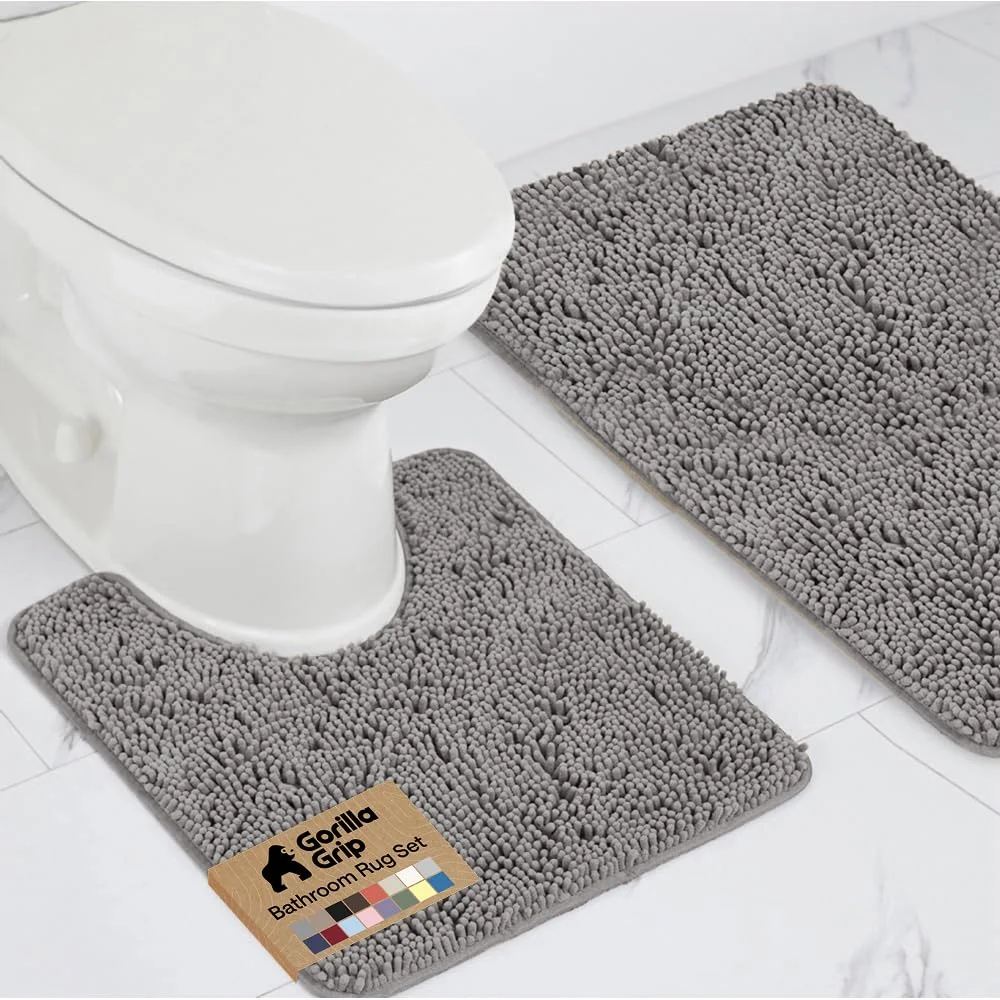
The floor around a toilet is geometry with a personality, and a rectangle fights it. The base has a curve that returns under the bowl, the supply line may hug one side, and the front of the base kicks into the room. Put a straight-edged mat there and you either crowd the front curve or you leave a wet crescent of tile right where toes land.
A U-shaped contoured mat exists for exactly that reason, because it gives the bowl a notch while keeping a clean edge around the sides, and in our catalogue the contour is around 24x19 inches. To measure, set the tape on the floor at the front-most point of the toilet base, then measure back toward the tank to see how deep a rug can go without climbing the bolts or colliding with the supply line. Then measure the available width from one side clearance to the other, and include the baseboard if it kicks out. Now center the U on the bowl and see where the edges fall, so the size reads as a frame around the base without pushing into walls or the side of a tub.
Injuries on or near the toilet climb steeply with age, about 4.1 per 100,000 among people aged 15 to 24 and about 266.6 per 100,000 among people aged 85 and over, and the rate for women was 72 percent higher than for men. That is a data way of saying this area deserves your attention, so do not put a loose throw here. Federal guidance from the National Institute on Aging asks that every carpet in a home be fixed firmly so it cannot slip, and advises against loose throw rugs, and a contoured mat with a backing that grips the tile does the job. Keep the walking line beside it clear.
What goes where, in materials that match the task
Each of these belongs to one zone, and the quickest way to see which is to picture it in the wrong one: chenille inside a wet tub, or a suction mat left out on the tile.
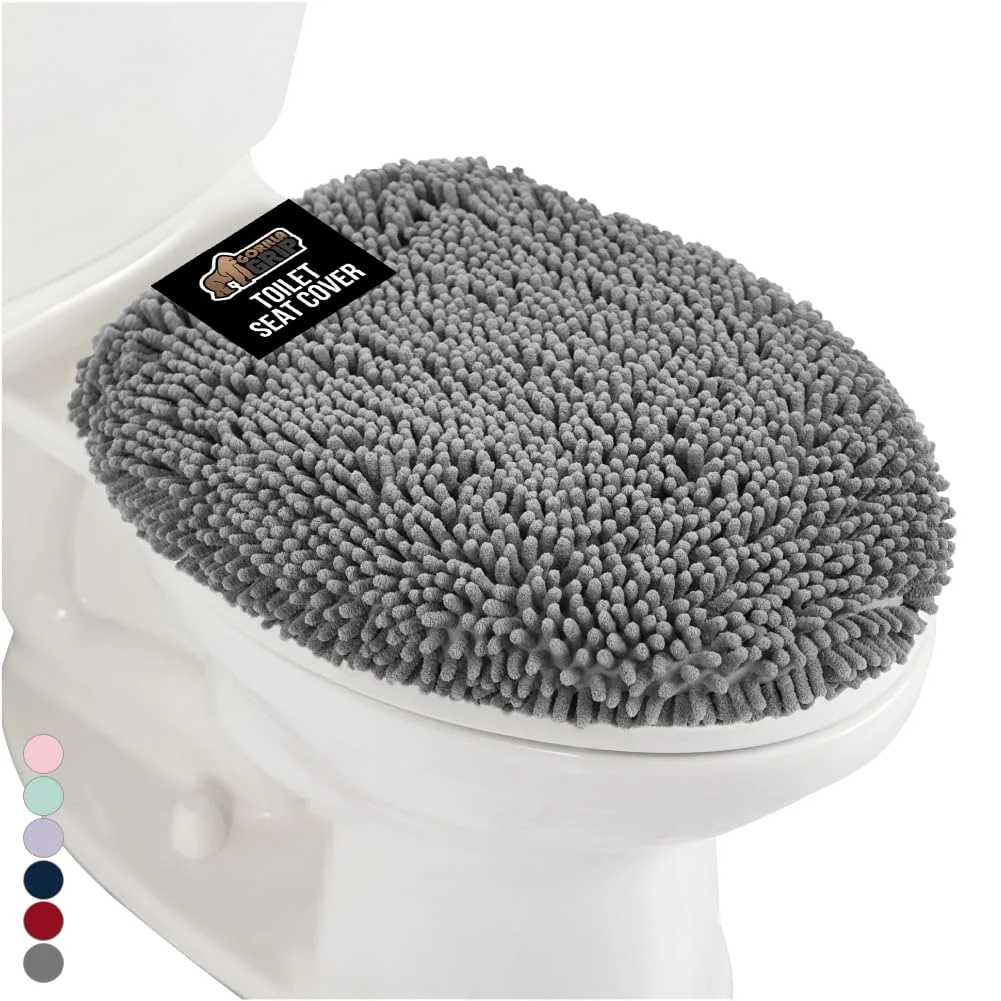
- Chenille belongs on the dry side of the tub wall. It is soft underfoot, drinks splash, and dries with air under it. It is machine washable.
- Memory foam is warm to stand on over cold tile. It holds water rather than shedding it. It wants air and a wash cycle. Keep it on the dry side and give it space to breathe.
- Suction rubber is a molded sheet with cups. It works inside the tub on a smooth clean surface. It will not hold on a textured or freshly refinished tub floor.
- Waffle weave is a flat textured cotton-feel weave in our shower curtains. At 72x72 inches, it contains spray and keeps more water where it belongs.
So the rule is one zone, one construction. Chenille and memory foam stay on the dry side of the wall, suction rubber stays inside the tub, and the waffle weave stays on the curtain rail.
Measure from the things that do not move.
Washing, backing, and time
All rugs age, and washing is part of their life. What you do in the laundry room decides how long a backing stays flexible, because rubber and some backing compounds harden under repeated heat, and hot cycles and high tumble speeds speed that change. Over time, a hard backing can crack and lose grip.
Wash cold, and tumble low or air dry, because that is the whole rule. Pull a mat out of the washer, shake it to lift the pile, and dry it flat or on a line with airflow, but do not park a damp rug over a floor register. Heat from below can bake a backing the way a dryer would, and if you see the backing begin to stiffen, move it to air dry only. A mat that no longer grips belongs in a place where grip is not a safety job, or it needs replacing.
Layout: where a mat should not go
Not every bare patch of tile wants a rug, so avoid placing a mat across a threshold where you change floor level, such as the top of a short step into a sunken shower room, and do not cover a transition strip. Keep a clear walking line for anyone unsteady on their feet, because a long runner that forces a path along a narrow wall can be a poor choice in a small bath. If someone in the household uses a walker or a cane, leave them the straightest line from door to sink to toilet without soft edges to catch, which is practical and polite.
Outside the bathroom the same question turns into a different one, because a rug on a hard floor moves for reasons of its own. That is the subject of Why a big rug walks, and what actually stops it.
Do not float a small throw in the middle of a walking zone, and the National Institute on Aging guidance is clear: use non-skid mats, strips or carpet on every surface that can get wet, and fix carpets firmly so they cannot slip. Avoid loose throw rugs, and fix what you place. In a bathroom that often means picking a rug with a backing that grips tile or stone, sized to the job, and then leaving the rest of the path bare and clean.
Sizes, coverage, and tradeoffs
A room decides what fits, and the table below gives a straight read of what each common size tends to cover, where it shines, and what it does badly, so use it to match your measurements to a shape that works.
Every size in that table is printed on the card it belongs to, along with the material and the colour, so the whole of the Gorilla Grip range can be measured against a tape before anything is decided.
| Size on the card | What it actually covers | Room it suits | What it does badly |
|---|---|---|---|
| 24x17 bath rug | A tight standing spot at a pedestal or small vanity | Powder rooms, narrow galley baths | Looks undersized in front of a double vanity, can float in a larger space |
| 30x20 bath rug | A standard single-sink standing zone with a bit of side room | Most hall baths | Can bind under a low door if plush, may crowd a tight toilet clearance |
| 36x24 bath rug | A generous sink area or the drip zone along a standard tub | Family baths with room to spare | Overwhelms a narrow bath, may cross into a door arc if not measured |
| 48x24 bath rug | A long run along the tub or in front of a double vanity | Primary baths with wider spans | Can bridge vents or meet baseboards if the space is not truly wide |
| 60x24 bath rug | A full-length runner effect along a tub or a wall of cabinets | Large primary baths | Too much rug in a compact room, likely to catch a door swing |
| 35x16 tub mat (suction) | The central stance in a standard tub floor | Standard tubs | Useless on textured or freshly refinished surfaces |
Keep the floor working for you
A bathroom floor is a working surface, so plan its soft pieces the way you plan a tool bench: you stand where the task is, you keep the path clear, and you put protection where water lives. You tie the look together with tone, but you size it to the realities that do not move. A sink mat that fits your stance, a drip-zone rug that fits the reach of your stride, a contoured mat that fits around the bowl you own, and a suction mat that fits the floor under the shower you take.
The three zones are on separate shelves for the same reason they take separate mats: what suits the dry side of the wall is the wrong object inside the tub. Gorilla Grip mats are sorted that way from the front page down.
One more small check at the end helps: after you place the mats, watch someone else use the room once, and you will see if a corner lifts or if a door clip is closer than you thought. Trim nothing, and slide the rug a half inch if you can. If you cannot, pick the next size down or change the layout, because the right mat is the one you forget about when you step, because it belongs exactly where your feet already wanted to go.
If you take one idea from all this, make it the habit to measure from the things that do not move, and the room will tell you what it needs. A calm, dry stance at the sink, a thirsty landing at the tub, and a shaped mat around the bowl, with backings that grip on clean tile. Cold wash, low tumble or air dry, and a clear path for anyone who needs it. Mats where they matter, and grab bars inside and outside the tub and shower. That is a bathroom floor, measured properly.
One button, the whole Gorilla Grip range
Every size, colour and pack count in we at Gorilla Grip sits behind this button, with the current price beside it. Pick your floor, check the size against a tape measure, and it ships from our retail partner.