Gorilla Grip: one idea, carried into eight rooms
Gorilla Grip has been making the same argument since 2014: the interesting half of a mat is the half you never look at.
Stand in a bathroom on a wet tile floor and the trouble is easy to name. The rug in front of the tub is soft, absorbent, the right colour, and it moves. Not far, and not all at once. Enough.
Everything in the catalogue came out of that one complaint, and out of the decision to answer it from underneath instead of weaving a prettier rug on top.
The back of a mat is the product
A floor finish is built to be smooth. Polished wood, glazed tile, enamel, sealed concrete: every one of them is easier to clean because it gives a foot less to hold on to, and a wet one gives less still. Whatever lies on top of it has to make up the difference across its whole footprint, and it has to do that without gluing itself down, without sealing water against the floor, and without leaving a mark when it is lifted.
Those three conditions fight each other, and that is the whole of the engineering. A backing aggressive enough to hold a rug still can soften a floor finish it sits on for a year. A pile deep enough to swallow the water off two feet can stay damp under itself for a week. A suction cup strong enough to hold through a shower has to let go cleanly on the day the mat is lifted. Nobody buys a product for the way it solves those three at once, and every product here is judged on it.
The face of a mat is what you look at. The back of it is what the mat is.
One idea, carried into eight rooms
The catalogue widened one complaint at a time, and the complaints turned out to be the same complaint wearing different clothes. A bath rug that skates on tile. A nine-by-twelve carpet that walks across a hallway a foot a year. A cutting board that slides on a wet counter while a knife is on it. A food bowl pushed halfway across a kitchen by a labrador who is not sorry. In each case the fix lives on the underside, and in each case it is a texture, a weight or a compound rather than a claim.
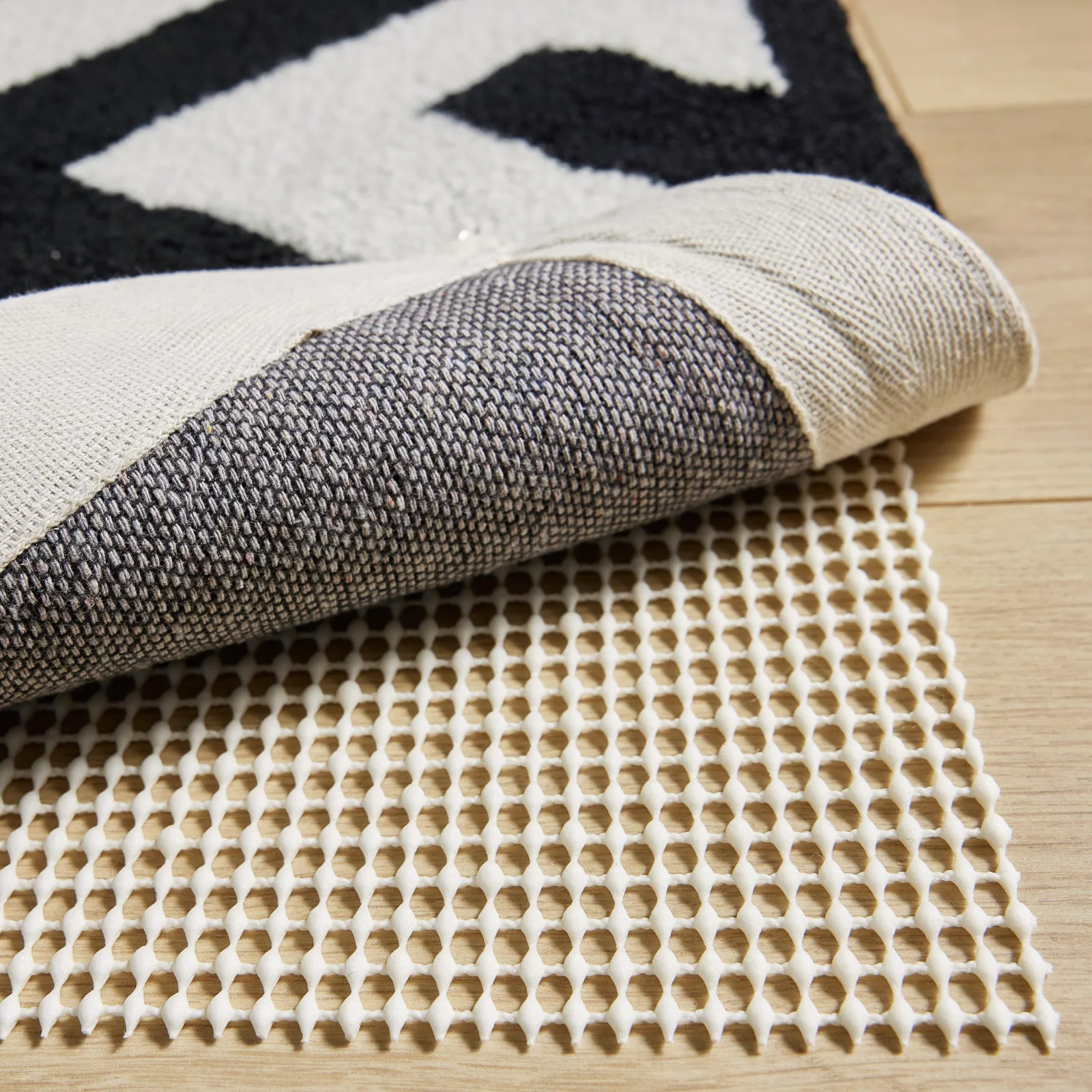
Around four hundred and thirty pieces sit on eight shelves now, from a corner gripper that costs less than a sandwich to a nine-by-twelve pad. The materials list is short, because there are only so many honest answers.
| Room | What moves | What goes under it | What changes |
|---|---|---|---|
| Inside the tub or stall | A bare foot on wet enamel | Moulded suction rubber | The mat seals to a smooth clean floor and releases when a corner is lifted |
| The dry side of the tub wall | A rug on tile, twice a day | Chenille or memory foam over a gripping backing | Water comes off the feet and the rug stays where it was put |
| Living room and hallway | An area rug creeping toward a door | Felt bonded to natural rubber | The rug stops travelling, and gains thickness and quiet with it |
| Kitchen floor and drawers | A standing mat, a liner, a board on a wet counter | Cushioned backing and grip liner | The mat holds the working line and the drawer stops rattling |
| Front door and porch | Grit and water arriving on a sole | Open mesh and rubber backing | The dirt stops at the door instead of in the hallway |
| Feeding corner and litter box | A bowl pushed by a determined nose | Waterproof silicone and coiled mesh | The bowl stays put and the spill has somewhere to sit |
Within a shelf the pieces come in families rather than one-offs. A bath rug exists at five lengths because bathrooms do, and in a dozen colours because the rest of the room was decided before the rug was. That sounds like merchandising and is mostly geometry: the 24x17 and the 60x24 are the same object solving a wall of a different length, and the backing on both is the part that had to be got right once.
What a few hundred thousand ratings are good for
The rating pools behind this catalogue run into the hundreds of thousands, counted once per product family rather than once per colour. That number is worth being precise about, because it is easy to wave around and easy to misread.
What it does tell you: these are not prototypes. A backing compound that hardens after ten hot washes, a cup that stops sealing after a season, a pile that mats down in a month, all of that surfaces quickly when enough households are standing on the thing every morning. Volume is a slow, blunt, entirely real test, and the designs that came through it are the ones still on the shelves.
What it does not tell you: whether a given mat suits your floor. A tub with a moulded non-slip texture defeats suction no matter how many people are happy with the same mat in a smooth tub. That is a question about your bathroom, and the answer is on the card and in the guides rather than in the star count.
Four figures on a card
Every card in the catalogue prints the same four things: the size in inches or feet, the count in the pack, the material, and the colour. Three of those are for the floor and one is for the eye.
The size is there because a bath rug bought by eye is a bath rug returned by tape measure. A 24x17 covers the standing spot at a sink. A 48x24 runs the length of a tub. A 6x9 pad goes under a 6x9 rug and gets cut an inch smaller on each side. None of that is interesting until you are the one holding the tape, and then it is the only thing that matters.
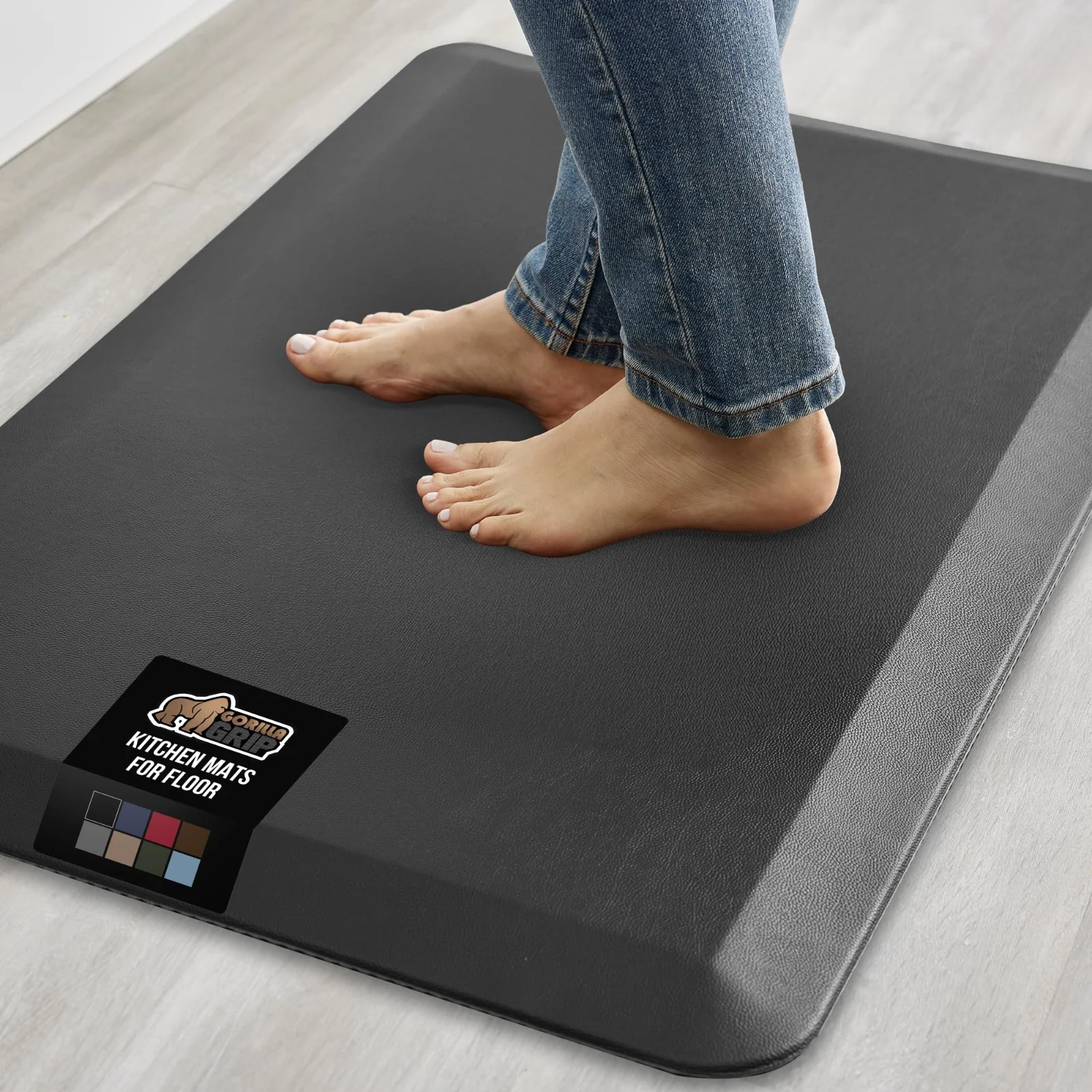
The material is there because it decides the room. Chenille belongs on the dry side of a tub wall, where it can take the water off two feet and dry with air underneath. Suction rubber belongs inside the tub, on a floor smooth enough to seal against. Felt and rubber belong under a rug, out of sight for years. Put any of them in the wrong room and it will disappoint you, and it will be the right product doing the wrong job.
Where the idea stops
A mat lowers the odds. It does not abolish them, and the honest version of that sentence is worth more than any promise we could make instead. Around two thirds of the US bathroom injuries that reach an emergency department happen in or around the tub or shower, and federal guidance asks households for non-skid mats on every surface that can get wet AND grab bars inside and outside the tub. That is an and. Nothing on these eight shelves is a substitute for the bar, and a rug lying in the walking line of somebody unsteady on their feet is better gone than better gripped.
What we will stand behind is narrower and duller than a promise about safety: the figure on the card is the figure on the product, the photograph is the thing being sold, and the underside was the part we worked on longest. Measure your floor, pick the material that suits the room, and the floor stops being something you think about.
01Where to start
The eight shelves Gorilla Grip is divided into
428 pieces, sorted by the room they end up in rather than by what they are made of.
02The brand, briefly
Gorilla Grip: questions people ask first
What the name covers, how long it has been on the market, and what happens when a buying button is pressed.
What does Gorilla Grip make?
Mats, rugs, pads and the small tools that go with them: bath rugs and toilet mats, tub and shower mats, rug pads and grippers, kitchen and door mats, pet mats, liners, boards and gloves. Eight shelves, and one question asked eight ways.
How long has Gorilla Grip been around?
Since 2014. That is the earliest date this catalog can show for itself, and it is the only figure on this site that we state about ourselves rather than about a product.
What are you paying for in a Gorilla Grip mat that a cheaper one lacks?
The underside. A floor finish is built to be smooth, and whatever lies on it has to make up the difference across its whole footprint without gluing itself down, without sealing water against the floor, and without leaving a mark when it is lifted. Those three conditions fight each other, and that is where the money goes.
Is Gorilla Grip only a bathroom brand?
It started at the bathroom floor and did not stay there. The same complaint turns up under a hallway rug, under a cutting board on a wet counter and under a dog bowl, and each of those became a shelf. Five of the eight shelves here have nothing to do with a bathroom.
Who is a Gorilla Grip mat for?
Anyone whose floor is harder and smoother than it used to be. Polished wood, glazed tile, sealed concrete and enamel are all easier to clean because they give a foot less to hold on to, and every one of them is more common in a house built or renovated in the last twenty years.
One button, the whole Gorilla Grip range
Every size, colour and pack count in the Gorilla Grip selection sits behind this button, with the current price beside it. Pick your floor, check the size against a tape measure, and it ships from our retail partner.